Introduction
Artificial intelligence (AI) is no longer confined to research labs or speculative innovation cycles. Instead, it has been rapidly integrated into enterprise workflows, consumer platforms, and industrial systems. As of 2026, billions of dollars continue to flow into AI startups, with investors prioritizing scalable infrastructure, domain-specific intelligence, and autonomous systems. In fact, global investment trends indicate that AI remains one of the most capital-intensive and strategically significant sectors in technology today.
Moreover, the competitive landscape has shifted. While established players like OpenAI and Google DeepMind dominate headlines, a new generation of startups is quietly reshaping the future of AI. These companies are not merely building chatbots—they are redefining search, cybersecurity, robotics, healthcare, and even data ownership.
1. Zhipu AI (Z.ai)
Zhipu AI, internationally branded as Z.ai, has emerged as one of China’s most competitive large language model (LLM) developers, strengthening its position in the rapidly evolving global AI market. The company’s GLM series serves as a viable alternative to Western LLMs, reinforcing its role in advancing domestic AI innovation. Notably, Zhipu AI has demonstrated strong commercial traction, with revenue growing by over 130% in 2025, signaling increasing adoption and market confidence.
In addition, its ability to optimize AI performance on domestically produced chips highlights a critical shift toward technological self-reliance, reducing dependence on foreign hardware while enhancing the resilience of China’s AI ecosystem. From a broader strategic standpoint, Zhipu AI reflects the accelerating global push toward AI sovereignty, where nations prioritize building independent, secure, and scalable AI infrastructures. This movement underscores a growing emphasis on controlling data, strengthening local innovation capabilities, and maintaining regulatory autonomy in an increasingly competitive and geopolitically influenced AI landscape.
2. Moonshot AI

Moonshot AI has rapidly established itself as one of the most highly valued AI startups globally, driven by strong investor confidence and accelerated technological innovation. With a valuation of approximately $18 billion, the company continues to expand its influence within the increasingly competitive artificial intelligence landscape. Its flagship Kimi AI model stands out for its advanced coding capabilities and multimodal functionality, positioning it as a powerful solution for next-generation AI applications. Reports of a potential IPO further highlight Moonshot AI’s ambitions for global expansion and long-term market leadership.
From a strategic market perspective, Moonshot AI is positioning itself as a direct competitor to OpenAI, particularly across Asia where demand for sophisticated AI solutions is rapidly growing. Backed by major technology firms, the company is well-equipped to scale operations, accelerate research and development, and strengthen its ecosystem—enabling it to effectively challenge established players in the global AI industry.
3. Exa

Exa is redefining search in the AI era by moving beyond traditional keyword-based methods toward a model-centric, AI-native framework. The company develops search infrastructure specifically designed for large language models, enabling more accurate, context-aware information retrieval. By prioritizing machine-readable web indexing over conventional SEO practices, Exa allows AI systems to process and utilize data more efficiently—transforming how information is discovered and consumed in modern digital ecosystems.
The company’s momentum is further reinforced by strong growth indicators, including strategic backing from Nvidia and a valuation of დაახლოებით $700 million. As Exa expands into Asia-Pacific markets, it is positioning itself at the center of a rapidly growing AI adoption landscape. This expansion is particularly significant as AI-generated answers increasingly replace traditional search engines, with Exa building the core infrastructure that powers AI-first discovery. As a result, the company is playing a critical role in shaping the future of intelligent information access.
4. Kled AI

Kled AI introduces a fundamentally new approach to data collection by reshaping how AI training datasets are sourced, incentivized, and governed. Instead of relying on large-scale web scraping, the company compensates users for contributing real-world data, creating a structured, participatory system for dataset generation. This model prioritizes ethical data sourcing by emphasizing transparency, informed consent, and fair compensation, while also improving the quality, diversity, and relevance of training data used in modern AI systems.
From a growth perspective, Kled AI has gained strong traction, reaching over 200,000 users and processing approximately 5 million daily uploads, reflecting rapid platform adoption. The company is valued at around $150 million, signaling rising investor confidence in its data-centric strategy. More broadly, this approach has significant industry implications, as it accelerates the shift toward a user-owned data economy, where individuals retain greater control over how their data is created, shared, and utilized in AI model development.
5. Kai (AI Cybersecurity Startup)

Cybersecurity has emerged as one of the fastest-growing sectors within artificial intelligence, and Kai is positioning itself at the forefront of this transformation. The company focuses on AI-driven threat detection and automated response capabilities, enabling faster identification and mitigation of security risks across increasingly complex digital environments. Unlike many competitors that expand through acquisitions, Kai has developed its platform in-house, allowing for tighter system integration, enhanced performance, and a more unified approach to cybersecurity operations.
To date, Kai has raised approximately $125 million in early-stage funding, reflecting strong investor confidence in its AI-native security architecture. As cyber threats continue to scale in both volume and sophistication, platforms like Kai are being viewed as critical digital infrastructure. By leveraging artificial intelligence for real-time threat detection and autonomous response, the company is well-positioned to address evolving security challenges more efficiently than traditional, rules-based cybersecurity systems, reinforcing its strategic relevance in the modern threat landscape.
6. Sarvam AI

Sarvam AI is at the forefront of the shift toward localized artificial intelligence ecosystems designed to address region-specific linguistic and cultural needs. The company develops multilingual large language models optimized for Indian languages, improving accessibility and usability across a highly diverse user base. It also employs a mixture-of-experts architecture to enhance computational efficiency, enabling scalable, high-performance, and cost-effective AI deployment.
In 2026, Sarvam AI released its 30B and 105B parameter models, marking a significant milestone in its large language model development roadmap. These advancements demonstrate the company’s increasing technical maturity and commitment to building robust AI systems tailored for multilingual environments. More broadly, Sarvam AI’s work underscores the growing importance of region-specific AI models, which are becoming essential for global scalability, inclusive AI adoption, and effective deployment across diverse linguistic markets.
7. Baseten

Baseten provides AI deployment infrastructure built to support production-grade machine learning applications at scale. The company specializes in high-performance model inference, enabling fast, reliable execution of AI systems in real-world environments. It also focuses on cost-efficient enterprise scaling, helping organizations deploy and manage large-scale AI workloads while maintaining strong performance and operational efficiency.
In terms of impact, Baseten has achieved notable performance gains, including reducing processing costs by up to 225% and improving inference speed by approximately 25%. These optimizations reinforce its core mission of making AI deployment more efficient and accessible. More broadly, Baseten simplifies enterprise AI adoption by reducing infrastructure complexity, allowing companies without deep machine learning expertise to integrate, operate, and scale advanced AI systems with greater ease.
8. Modal Labs

Modal Labs is a developer-first AI infrastructure platform designed to streamline the deployment and management of machine learning workloads at scale. Its serverless architecture allows developers to run AI applications without managing underlying infrastructure, improving speed, efficiency, and operational simplicity. The platform also supports seamless scaling across CPUs and GPUs, enabling teams to dynamically allocate compute resources based on workload demands while optimizing both performance and cost.
By abstracting complex infrastructure management, Modal Labs enables the rapid deployment of sophisticated AI systems with minimal configuration. This reduces operational overhead and accelerates development cycles, allowing engineering teams to focus on building, iterating, and optimizing AI applications rather than handling deployment logistics. As a result, the platform plays a key role in simplifying modern AI infrastructure and improving developer productivity.
9. Ranketta
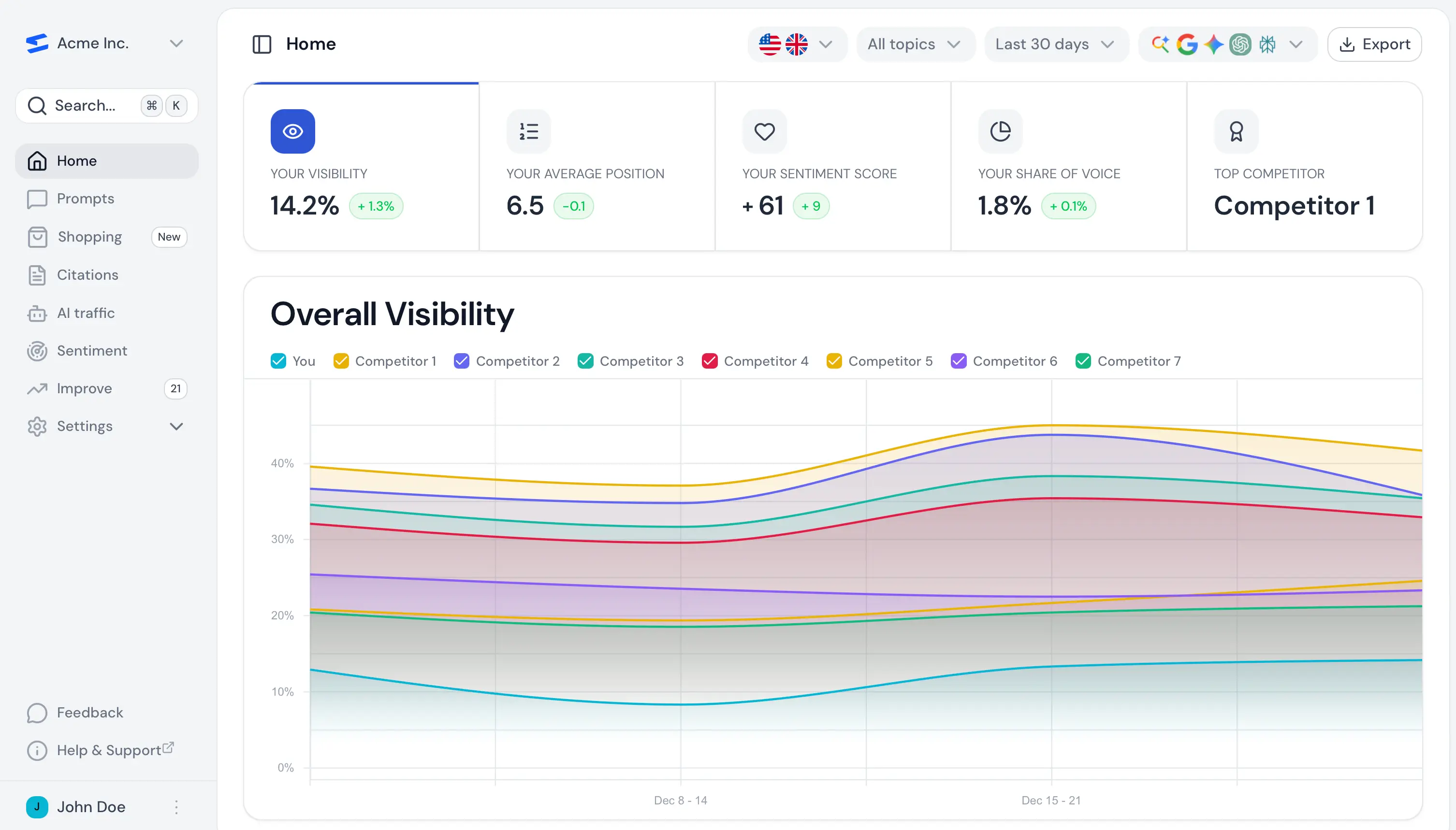
Ranketta is pioneering the emerging category of AI visibility optimization by helping brands understand and improve how they appear in AI-generated answers. The platform monitors brand presence across large language model outputs and AI-driven search environments, providing clear visibility into how often and in what context companies are mentioned. It also delivers actionable insights that help organizations refine their content strategies and better align their digital presence with how modern AI systems retrieve and present information.
As generative AI continues to reshape search behavior, Ranketta provides valuable market insight into the transition away from traditional search engines toward AI-powered discovery. By optimizing brand visibility in AI-generated responses, the platform enables businesses to maintain relevance, strengthen competitive positioning, and adapt effectively to evolving AI-first search ecosystems.
10. Atomesus AI

Atomesus AI is part of a new wave of democratized AI platforms focused on expanding access to advanced artificial intelligence across a wider range of users and organizations. The company uses a hybrid AI framework that combines proprietary models with licensed technologies, offering flexibility in performance, deployment, and scalability. Its emphasis on accessibility and affordability is aimed at reducing the cost and complexity of AI adoption, enabling businesses to integrate advanced AI capabilities without requiring extensive infrastructure or high operational overhead.
Strategically, Atomesus AI plays a key role in broadening global access to artificial intelligence by lowering barriers to entry for advanced AI tools. This approach enables startups and small to mid-sized enterprises worldwide to leverage capabilities that were once largely restricted to major technology companies with significant resources. By prioritizing inclusivity and cost efficiency, Atomesus AI supports wider AI adoption and contributes to a more balanced and competitive global AI ecosystem.
Conclusion
In conclusion, the AI startup landscape in 2026 is defined not just by innovation, but by execution, scalability, and real-world applicability. The startups highlighted in this list represent a diverse mix of infrastructure providers, application developers, and disruptors across industries.
While some are already valued in the billions, others are still under the radar—yet equally transformative. Collectively, they signal a shift from AI hype to AI utility, where measurable impact takes precedence over experimentation.
For investors, entrepreneurs, and tech enthusiasts alike, keeping a close watch on these emerging AI startups is not just advisable—it is essential.
Click here to explore more trending TECH news shaping the future.