Introduction
The artificial intelligence revolution is no longer just about models and algorithms. It is being industrialized: vast sums are being deployed to build the physical and financial backbone that will host tomorrow’s generative AI, autonomous systems, and enterprise-grade cognitive services. In 2025, a new wave of AI infrastructure investments — from sovereign-backed compute hubs to chipmaker-led megadeals — has reshaped global priorities and supply chains. This article surveys the 10 Breakthrough AI Infrastructure Investments You Must Know announced or expanded in 2025, explains what each means for the market, and connects the dots between compute, power, policy, and profits.
1) NVIDIA → OpenAI: up to $100 billion framework to build gigawatts of AI data centers
Sheer scale, chip-to-data-center integration, and strategic verticalization.
NVIDIA and OpenAI announced a strategic partnership centered on deploying at least 10 gigawatts of NVIDIA systems to support OpenAI’s next-generation infrastructure. As part of that arrangement, NVIDIA indicated it would invest up to $100 billion in OpenAI progressively as each gigawatt is deployed. The initial deployments were described to start in late 2026 on NVIDIA’s Vera Rubin platform. The announcement was framed as a letter of intent and has subsequently been the subject of clarification and reporting about timing and finalization.
The deal highlights a trend where chip vendors are no longer merely suppliers but financial partners in customers’ infrastructure roll-outs, with ten gigawatts of AI capacity representing truly industrial scale—implying tens of thousands to millions of next-generation GPUs and massive demands for power, cooling, and real estate—and this combined structure of supply plus financial investment accelerates the availability of specialized hardware while potentially shifting bargaining power toward hardware providers.
Antitrust scrutiny was flagged by analysts, and company statements emphasized that the framework was still being finalized in late 2025. Investors and regulators were watching whether such integrated deals might limit competition for cloud and chip customers.
2) NVIDIA & Microsoft → Anthropic: strategic investments + $30 billion Azure compute commitment
Ties hardware, cloud, and model developer together — a new template for scaling model providers.
Anthropic (maker of Claude) committed to purchase roughly $30 billion of compute capacity from Microsoft’s Azure, and in parallel NVIDIA said it would invest up to $10 billion in Anthropic while Microsoft committed up to $5 billion. Anthropic also agreed to contract up to 1 gigawatt of additional capacity using NVIDIA hardware platforms. The package was presented as an alliance to compete with other major model providers and to offer enterprise customers expanded model choice.
The arrangement binds cloud capacity, chip supply, and model development into a co-investment model—a pattern being repeated across the industry—and for governments and enterprises concerned about vendor lock-in, it offers an alternative to the OpenAI-centric ecosystem, even as it simultaneously intensifies overall industry consolidation.
The size of the compute commitment and the multi-party financing structure raises questions about commercial terms, governance, and resilience if workloads or budgets shift.
3) Brookfield + Qatar (Qai) → $20 billion AI infrastructure joint venture (Qatar)

Sovereign-backed regional compute hubs are reshaping global AI geography.
Brookfield (via its new Artificial Intelligence Infrastructure Fund) partnered with Qatar’s newly created national AI company, Qai, to launch a $20 billion joint venture aimed at building integrated compute centers and positioning Qatar as a regional AI hub. The JV will back data center capacity, high-performance computing facilities, and related services to expand regional access to AI compute.
The Middle East has been making aggressive strategic investments to diversify away from hydrocarbons, and AI infrastructure has become a core part of that plan, with sovereign capital—such as Qatar’s—able to underwrite projects that private investors might view as too long-dated or capital-intensive.
Projects of this scale require long-term power, fiber, and regulatory stability. They are often sensitive to geopolitics and export-control regimes around advanced chips and technology.
4) Microsoft → $17.5 billion investment in India (cloud + AI infrastructure)

Major expansion into the world’s fastest-growing hyperscale market.
Microsoft announced a $17.5 billion investment planned over the next four years into India, focused primarily on expanding cloud and AI infrastructure, building hyperscale data centers, and supporting local AI capabilities. The announcement was made during executive visits and discussions with Indian government leadership and included commitments to local hiring and sovereign capabilities.
India is being targeted as a future AI innovation hub, with large hyperscale clouds essential for enabling local enterprise digital transformations and sovereign cloud offerings, and investments of this magnitude expected to catalyze local talent development, strengthen partnerships with regional universities, and accelerate enterprise adoption of AI.
Microsoft’s plan should be seen in the context of competing commitments from Google and other hyperscaler’s; regulatory and data-sovereignty concerns will shape implementation.
5) Google → $15 billion AI hub in Visakhapatnam, India

Another hyperscaler doubling down on India, making the country an AI infrastructure battleground.
Google announced a $15 billion investment to create a major AI data hub in Visakhapatnam (Andhra Pradesh). The project combines data center capacity, subsea connectivity, and gigawatt-scale compute resources to host Google’s full AI stack. The hub has been positioned as one of Google’s largest investments outside the U.S. and was framed as a multi-year, multi-GW project.
Multiple hyperscalers placing multi-billion-dollar GPU-scale hubs in India will expand local compute availability and help enterprises run large models closer to home, while simultaneously driving competition for talent, renewables, and local supply chains such as cooling, power, and fiber.
As with other projects, the energy footprint and sustainability commitments (e.g., renewables and water use) are key public-policy issues.
6) Amazon → $50 billion plan to expand AI and supercomputing for U.S. government clients

Public-sector supercomputing commitments can unlock large, dedicated demand for hyperscale infrastructure.
Amazon announced plans to invest as much as $50 billion to expand AI and supercomputing capabilities tailored for U.S. federal government customers. The plan included adding roughly 1.3 gigawatts of capacity via specialized data centers and federal-focused designs. The investment reflects both market demand (government buys) and the strategic nature of AI in national security and public services.
Government contracts factor differently from enterprise deals because they often provide length, scale, and mission-critical requirements that spur investment in secure and compliant infrastructure, and this type of commitment also supports specialized service offerings such as cleared computing, sovereign clouds, and isolated networks.
Security constraints and procurement complexity can slow deployment; however, governments can be anchor customers for long-haul infrastructure investments.
7) Cerebras Systems → $1.1 billion Series G (AI infrastructure funding)

A focused hardware player raised large private capital to scale wafer-scale compute platforms.
Cerebras Systems closed a $1.1 billion funding round (Series G), bringing its valuation into the multi-billion range and enabling further expansion of wafer-scale AI chip production and systems. The round was led by major institutional investors and was explicitly tied to scaling products that serve hyperscalers, national labs, and enterprise AI clusters.
Specialized chip architectures—such as wafer-scale designs and other domain-specific accelerators—are being funded to complement GPUs, as customers seeking greater efficiency and lower operational costs increasingly evaluate alternatives to GPU-only stacks, and these large funding rounds for hardware innovators help foster competition in an ecosystem that has long been dominated by only a few major vendors.
Hardware startups face manufacturing and supply-chain risk (e.g., reliance on TSMC) and must demonstrate real TCO advantages to displace incumbent architectures.
8) Graphcore (SoftBank) → ~$1 billion planned investment & India expansion
Chip designers and IPU providers are expanding abroad to secure talent and market access.
SoftBank-owned Graphcore announced plans to invest up to $1 billion in India over the next decade and to open AI engineering centers there — investments intended to boost local design talent and support infrastructure expansion. Graphcore’s plan was framed as part of its broader global expansion strategy.
Diversifying development footprints and deepening local engineering ROIs helps companies navigate geopolitical constraints and capture local market demand, while IPU (Intelligence Processing Unit) designs continue to serve as an important alternative to GPU-centric compute for specific classes of AI workloads.
Investors should note that hardware product cycles and end-customer adoption are long; Graphcore will need continued R&D execution to capitalize on this funding.
9) SambaNova & partners → sovereign, renewable-powered AI clouds and regional projects (UK, Australia, Germany, etc.)

Sovereign clouds and energy-efficient inference platforms are a staple of enterprise/regulatory demand.
SambaNova and several regional partners announced multiple sovereign and renewable-powered AI cloud projects — most notably a UK initiative to build a renewable-powered sovereign AI cloud at the Killellan AI Growth Zone that is expected to enable tens of billions in investment and multi-hundred-MW capacity ranges. Similar initiatives were announced in Australia and Germany. These projects emphasized energy efficiency, inference-optimized hardware, and data residency/compliance.
Enterprises and governments that must comply with GDPR, national security, or industry regulations increasingly demand local, energy-efficient AI infrastructure capable of supporting large models without transmitting sensitive data offshore, and projects that integrate renewables, on-site storage, and inference-optimized silicon are designed to lower operating costs while minimizing regulatory friction.
Sovereign projects can be expensive and complex; they often require public-private cooperation and careful planning to ensure local benefits such as jobs and technology transfer.
10) Microsoft → $10 billion investment in Sines, Portugal (SINES data campus)
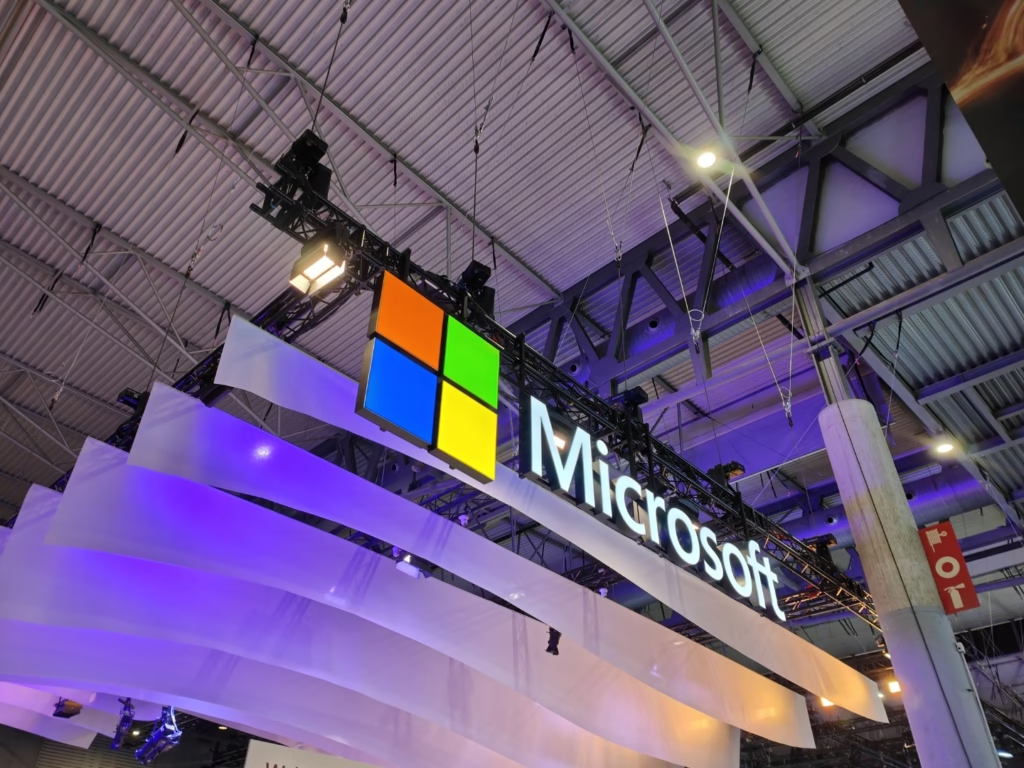
European data-center megaproject backed by hyperscaler money and global supply chains.
Microsoft announced plans to invest approximately $10 billion in an AI data center hub at the Start Campus SINES Data Campus (Portugal). The investment ties Microsoft to a coastal, subsea-cable-friendly location intended to host large-scale GPU deployments (reports noted plans to deploy thousands of NVIDIA GPUs) and renewable power arrangements. The SINES site had been developed as a 1.2GW AI-scale IT campus and Microsoft’s engagement catalyzed additional investor interest.
The deal exemplifies how hyperscalers scale compute capacity in regions with subsea connectivity and renewable power potential, with large, publicly visible investments by Microsoft helping to create a regional ecosystem encompassing construction, energy, maintenance, and managed services.
Permitting, grid integration, and water/energy policy will shape how fast such megaprojects can be scaled.
Conclusion
The 2025 wave of AI infrastructure investments shows that the technological race is now also a capital and geopolitical race. The winners will be those who manage compute economics (power + cooling + chip efficiency), market access (regional compliance + subsea connectivity), and strategic alignment between models and the physical stack. As the market matures, prudent diversification, careful contract structuring (to avoid lock-in), and rigorous sustainability planning will be the hallmarks of successful deployments.
If you’re building strategy or planning an investment, the top-line advice is straightforward: plan for scale, lock in resilience, and verify vendor economics before signing multi-year commitments.
Read more trending TECH news here.